
As an Occupational Therapist working with toddlers, I often notice that toddlers are ready to learn more than their parents may suspect. A great way to foster learning and independent play in toddlers is with the use of toys. Here are a few of my favorite toys and activities which I use in sessions to help toddlers learn. All of these toys are tested by me and the children I work with and have been found to be highly effective
These wonderful lightweight toys come 6 in a pack. There are 6 different colors, allowing you to work on naming colors. The toys will stick to smooth surfaces such as a stainless steel refrigerator. The suction nature of the cups means that the child needs to use arm and hand strength to push them onto a surface, and also requires hand strength to pull them off. Once stuck onto a surface the child can place smaller objects inside to work on counting. This toy is highly recommended for parents and therapists/ teachers of toddlers
This toy has weighted pieces which are of various sizes. The toy can encourage learning sizes of objects and how to stack them in size order. The larger pieces require hand strength and possibly the use of 2 hands together to pick it up, encouraging bilateral hand skill development.
3. Bubbles
Bubbles are inexpensive wonderful toys to use with your toddler. Blow the bubbles and teach the words “bubbles”, “pop” “circle”. The child is practicing visual motor tracking skills as they watch the bubble descend to the floor. The are practicing eye hand coordination when they try to pop the bubble. As a slowly moving target. If the are able to use their pointer finger to pop the bubbles, they are practicing finger isolation and pointing skills. The child will also likely be quite attentive to this activity, and therefore you are practicing sustained attention skills.
4. Yoga cards
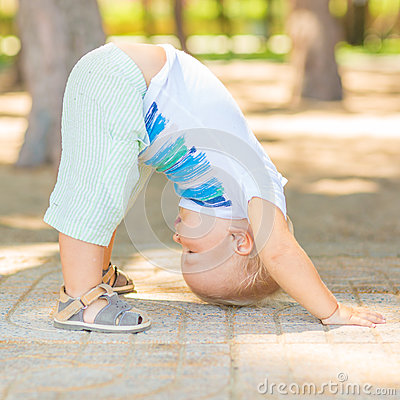
Many parents are shocked by the idea that their toddler might be able to do yoga. The trick is to work on it incrementally, starting with just 1-2 poses in a session and praising them/ hugging them for their effort and attention (not just when they get the pose completely right which may take time). To start, buy an inexpensive yoga mat. Turn on some gentle music (you can search for yoga related music on you tube or wherever you listen to music). Then take out one (easy) card and do the pose. When you finish, say “yay I did it” and then say “your turn”. Gently help your child try the pose. If your child tries, say “yay you did it” and give them a hug, high five or a back rub. If they appear to be enjoying the activity try another card. In the first session, keep it short, gentle and positive. The 2nd time you try (the next day or later), you may be surprised to see what they remember. You can also at this time add a third pose or more. Take cues from your child and make it a joyful experience.
4. Sing a clean up song and practice placing items into containers, sweeping or wiping a surface etc.
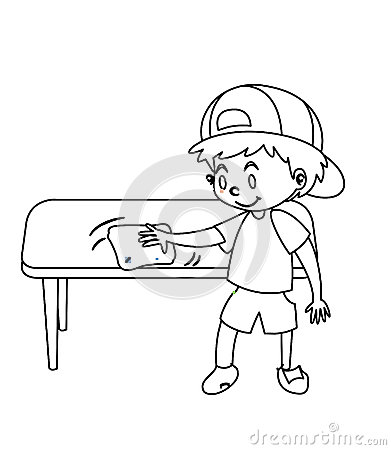
If you pair an activity with a song it can be really useful for your child. Once they learn that a particular song means doing a particular thing, they learn the skill and can start to generalize it. In other words, play a clean up song while you help the child put their blocks back into a bin. Play or sing a clean up song while helping your child wipe down the table.
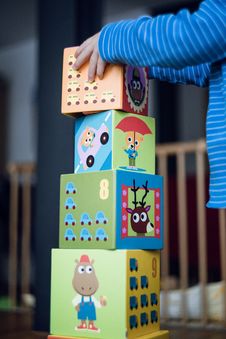
Teaching your child to stack and nest large stacking blocks is another wonderful skill for them to learn. Teach size (which one is the biggest?). Teach positional words (put “on”). The larger blocks will require your child to hold it with 2 hands, encouraging bilateral hand skill development. As the blocks get stacked, your toddler will need to realize that they need to stand up to reach to the highest point. When all are stacked your child can practice knocking them down and then collecting them all. Then nesting them back together is another skill which will require learning size order and bilateral hand skills.
I hope these activities and toy suggestions will help you and your child, or the child you are working with, to have many successful learning opportunities!
 notesandnoggins